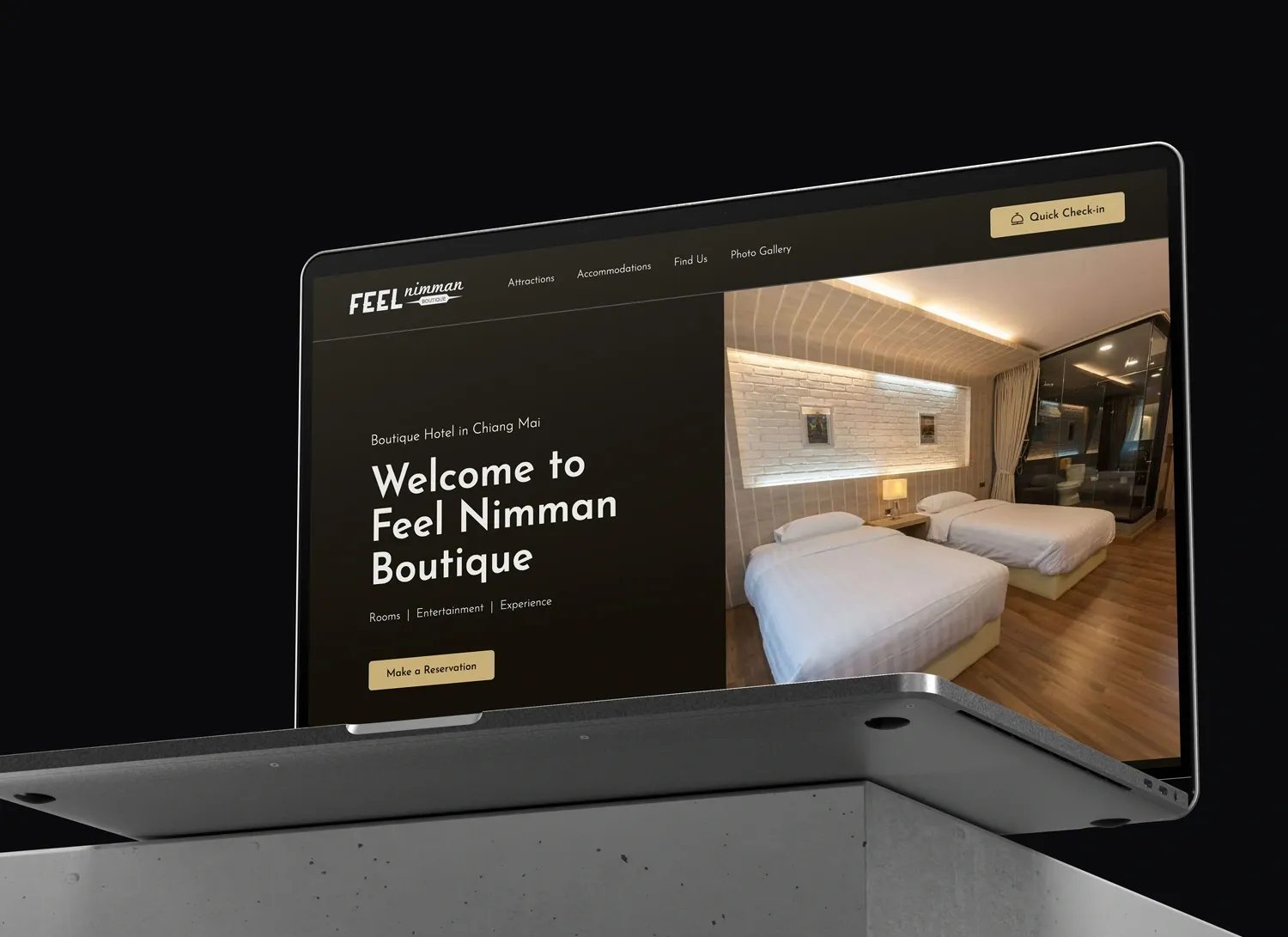
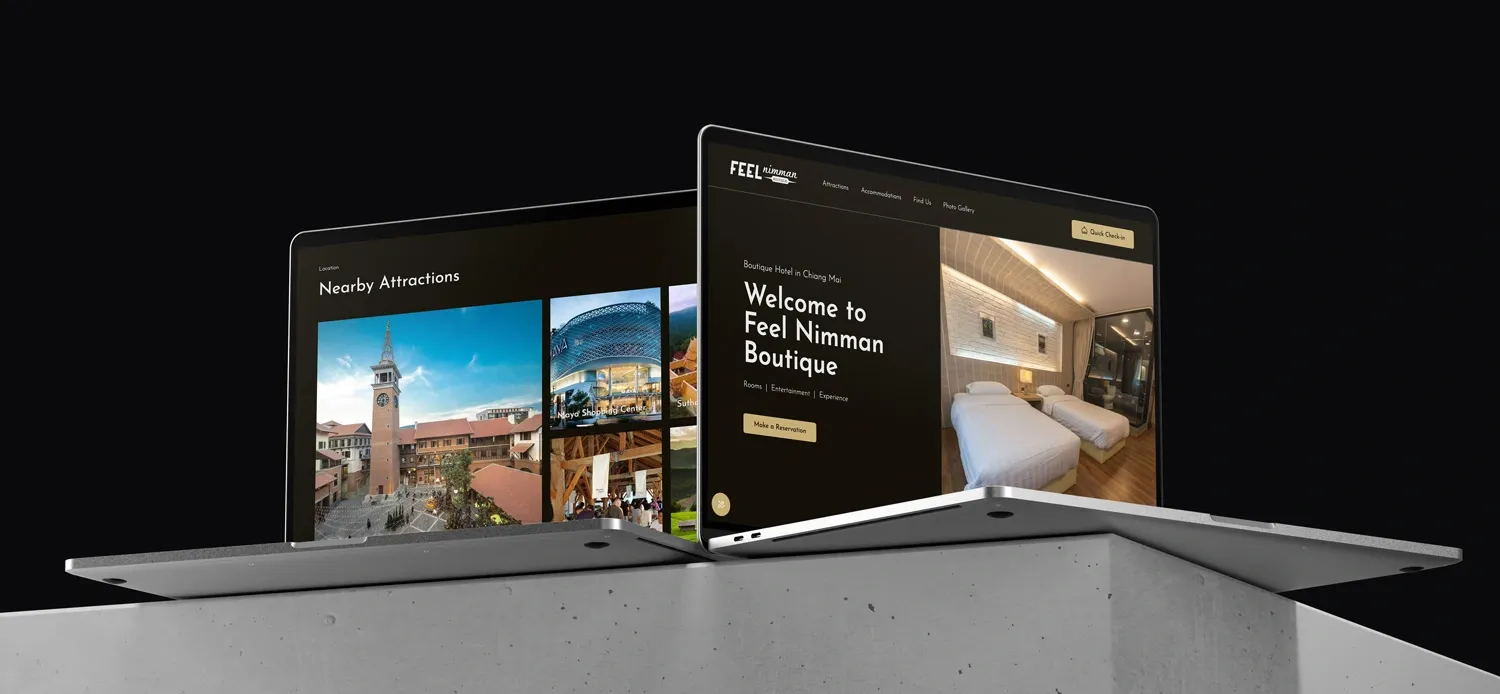
Feel Nimman Boutique เป็นโรงแรมดีไซน์ 8 ห้องย่านนิมมานเหมินท์ เชียงใหม่ เดินไม่กี่นาทีถึง One Nimman, Maya และคาเฟ่กับที่เที่ยวกลางคืนรอบ ๆ เราออกแบบและพัฒนาเว็บไซต์ของโรงแรม ระบบเช็คอินด้วยตัวเอง และผู้ช่วยแชท AI ที่ตอบคำถามแขกตลอด 24 ชั่วโมง ได้ออกมาเป็นเว็บไซต์ที่เปิดจากมือถือก็ลื่น จองตรงกับโรงแรมได้ เช็คอินผ่าน QR โดยไม่ต้องใช้กระดาษ และมีพนักงานต้อนรับดิจิทัลที่คอยรับคำถามซ้ำ ๆ ให้ทั้งภาษาไทยและอังกฤษ
Feel Nimman Boutique is an 8-room design hotel in the middle of Chiang Mai's Nimman, and it needed more than a brochure site. The location is its edge, and the competition is fierce:
Check-in was slow and paper-heavy:
And the same questions kept landing on every channel — LINE, email, the OTAs:
The owner and staff spent the day answering FAQs instead of running the hotel. Our job was to turn the site into a digital front desk: sell the rooms and the location, digitise check-in, and let an AI assistant field the repeat questions.
We rebuilt the site around what a guest needs to decide. Where it is and what's nearby: a clear location section for One Nimman, Maya, CMU and the key distances. What the rooms are and what they cost: cards for the Standard Single, Deluxe Twin, Deluxe King and 2-Bedroom Penthouse with a "Check availability" path. And why to book direct: the weekly, monthly and early-bird offers shown on-site instead of buried in an OTA. It's one scrollable, mobile-first page with obvious routes to booking and quick check-in.
The property is small and design-led, so the site is too: large, clean photography of the rooms and common areas, minimal type that reads in both Thai and English, and an editorial calm instead of a generic "hotel theme". It looks like Feel Nimman — small, intentional, in the heart of Nimman — not a 200-key city block.
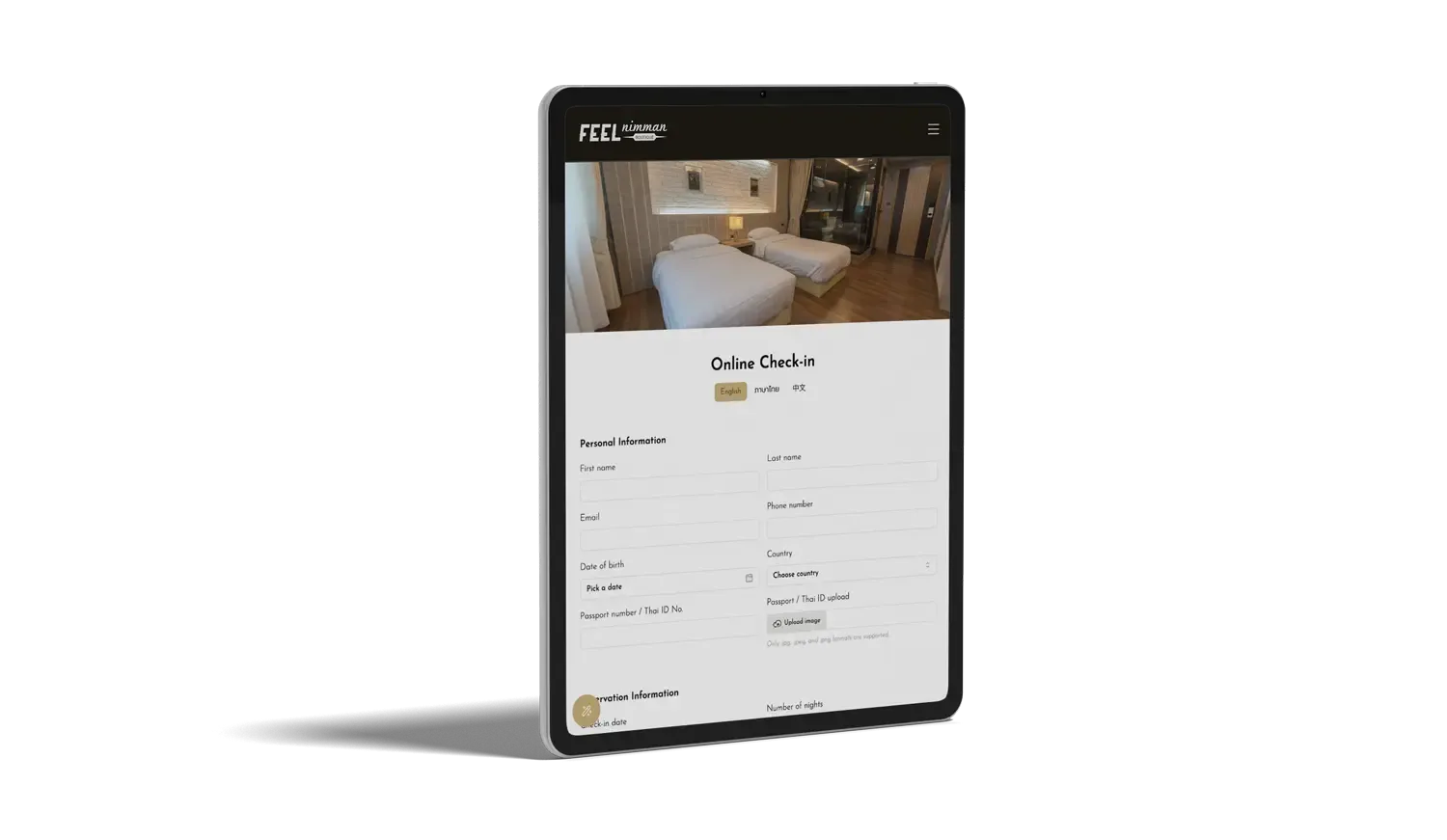
We built a QR-based self check-in wired to a secure backend. A guest scans the code at reception or before arrival, lands on a short mobile form for their personal, stay and contact details, and uploads an ID or passport photo straight from the phone. Everything lands in a secure database and admin instead of a handwritten form. The flow is linear and short, built for someone standing in the lobby with a phone, with proper access controls so only authorised staff see guest data — which keeps the compliance side cleaner too.
To take the repeat questions off the team, we added an AI chat assistant trained on the hotel's FAQs, distances, room types, long-stay promotions and house rules. It answers most pre-booking questions in natural language, points guests to the right section (rooms, promotions, quick check-in, contact), and works around the clock. We tuned it to keep answers short, hand off to a human on edge cases, and cope with the language reality here: English, simple ESL phrasing, and copy-pasted Thai from the hotel's own content.
Underneath: a fast single-page site on our modern JavaScript stack (Next.js/React) with strong Core Web Vitals on mobile, a custom backend for the check-in records and basic usage analytics, and an AI layer connected to a managed LLM, so there's no model to host or babysit at the hotel. Day to day, none of it needs a developer.
Check-in is faster and cleaner: guests fill in their own details on their own phone instead of writing on paper and waiting for staff to re-type it. Records are digital from the start — easy to search, filter and export — and there are fewer errors, because guests type their own names and ID numbers.
The team does less repetitive work. The AI chat fields most of the location, parking, promotion and room questions before a guest arrives, and it answers late-night and off-hours enquiries too, which matters for travellers in other time zones. Staff now see new questions and booking requests instead of the same FAQ over and over.
And direct booking has a stronger case: the site puts the location, the rooms and the book-direct discounts front and centre, so guests have a reason to skip the OTA. Website, check-in and AI chat together behave like a small digital front desk — it informs, reassures and collects data instead of sitting there like a flyer.